
Brothers from Kappa Beta Chapter’s graduating classes from the 1960’s and 70’s were invited to attend a reunion on October 16-17, 2026. The following report was sent in from Brother Junius Allen (Kappa Beta, ’71), who has been planning for months with the Central Office to organize this event, with the desire to reconnect with the brothers he was active with nearly 60 years ago, as well as the lessons learned on life from the attendees.
“The gathering consisted of members with graduation dates mostly from 1967 to 1972. We started with a tour of old and new buildings and labs of the Bagley College of Engineering on Friday afternoon. Of particular interest was the Innovation, Design, and Engineering Education (IDEE) Laboratory. The IDEE lab provides students with hands-on learning opportunities that complement classroom instruction. The space helps students gain practical experience in design and manufacturing by offering access to advanced tools, collaborative work areas and mentorship. The lab duplicates well-equipped machine, welding, and electrical shops, which is a great addition to the engineering school. The participating brothers gathered Friday night at the local home of one of the brothers, and ate lunch the next day with current members at the Theta Tau house. The reunion continued with a late Saturday afternoon gathering to review memorabilia and reminisce about our time at MSU. We wrapped up on Saturday night with dinner at a local restaurant.”
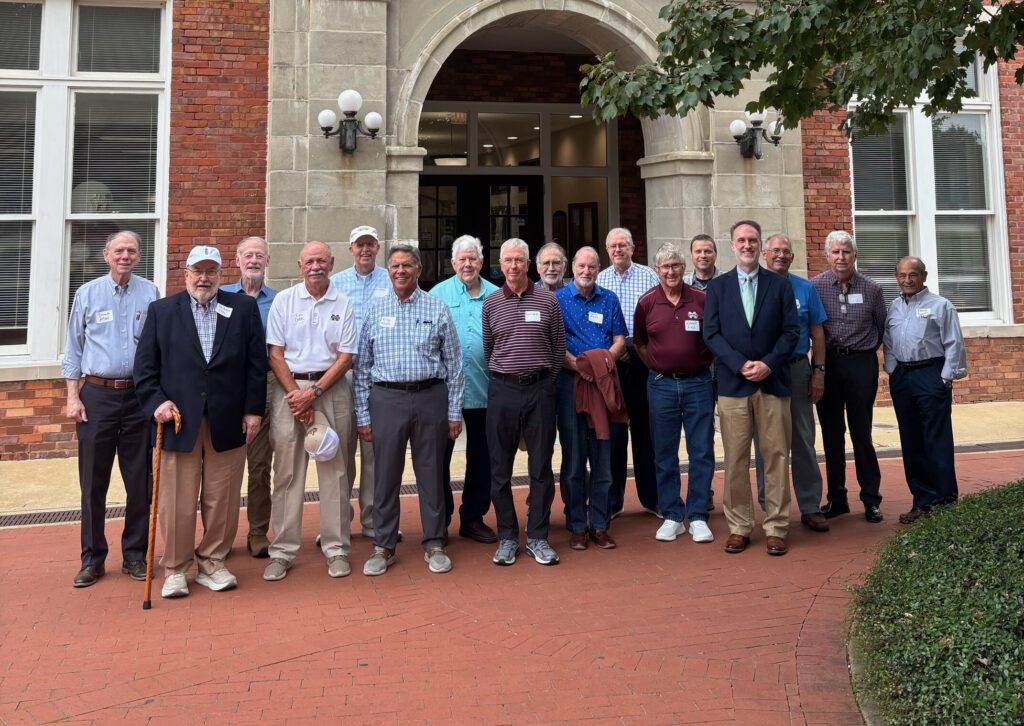
The above photo was taken in front of the McCain building after the Friday tour. Pictured from left to right, Junius Allen KB 113, Reuben Pitts KB 59, Chester Harris KB 136, Jim Carr KB 26, Jim George KB 134, Billy Magee KB 58, Charles Field KB 39, David Webb KB 152, John Grafton KB 135, Jerry Banks KB 135, John Floyd KB 74, Robert Field KB 92, Michael Floyd KB 498, David Ford (Dean of the engineering school), Mark Schowalter KB 122, Jim Keith KB 119, and Frank Ingels KB 62 (faculty advisor in the 1960s).
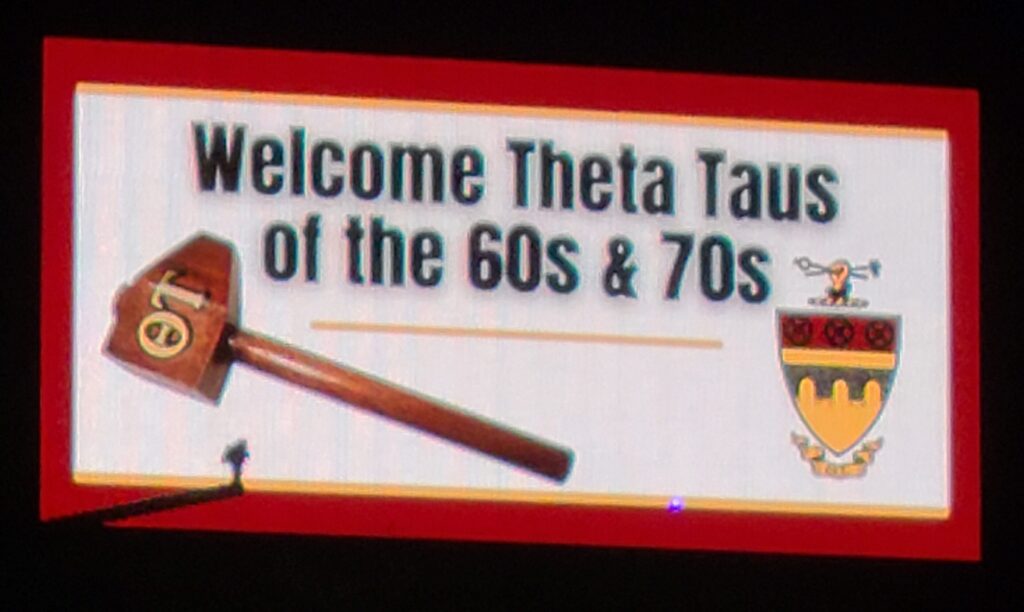
Another notable feature of the visit was the greeting on an electronic bulletin board owned by Gathian Wells, nephew of one of the brothers, outside the hotel where most of the visitors stayed.
“Several years ago I read an article in the Journal of the American Association of Individual Investors (AAII) which claimed that all the financial advice most people will ever need will fit on an index card. It occurred to me in preparing for the Kappa Beta reunion that we would have combined life experiences of over 1500 years. We ought to know some stuff and each of us should be able to summarize at least one important lesson on an index card. I asked those who attended to do that and give me the cards at the end of the reunion. Spouses were invited to do the same. Below are the responses.”
On Integrity and Getting it Right
For years I was the sole certification authority for the Navy’s Aegis Combat System. When you prevent a ship from making a scheduled deployment, you don’t want Navy leadership to suspect your judgment or your motives. Work hard; work smart; maintain your integrity at all costs. – Reuben Pitts, Mechanical Engineer, Kappa Beta #59
I flew as an airline pilot for Southwest airlines for 21 years. We often had other pilots fly in our cockpit jump seat who were commuting to work or for personal reasons. One day as I prepared for a flight – I was then a captain – a Southwest pilot entered the cockpit and asked if he could ride on the jump seat. This was normal procedure for our airline and as I turned to talk to the pilot, I recognized him as Hoot Gibson who was a former astronaut and shuttle pilot. Hoot Gibson had flown 5 missions in the Shuttle with 1 as the pilot and 4 as the commander of the shuttle. He also had an Aeronautical Engineering degree from Cal Poly and was a graduate of the Navy Test Pilot school. After he retired from NASA, he was hired by Southwest Airlines. Of course, I said “yes” he could ride with us in the cockpit.
When we reached cruise altitude and the aircraft was cruising happily on autopilot, I turned to Hoot and asked him questions about his life as an astronaut. I specifically asked him “What was the most frightening moment or event you experienced as an astronaut.” He told me that was an easy question and went on to tell me the following which I will describe as best I remember.
He said he was scheduled to launch on one of his missions as a commander. The weather around the area was good for a launch but the jet stream overhead was just out of limits. I think he said the limit for the shuttle launch was a jet stream no greater than 102 knots at around 40,000 feet. He then told me that the Shuttle and rocket system was designed to withstand the shear forces of entering the jet stream at a max wind speed of 102 knots. He also told me that the Shuttle system was designed to 100 percent of that capability. Not 150 percent like most fighter jets. So, he said if the jet stream was moving at 102 knots, he was fine but if 103 knots or greater, then the shuttle rocket system may break apart due to the stress.
He told me there were T-38 jet aircraft flying at 40,000 feet over the shuttle area measuring the jet stream speed and calling it out to the launch personnel who passed it on to the shuttle crew. The callouts began at 105 knots, then 104 knots and so on. Hoot knew that when the callouts hit 102 knots, he and the shuttle will launch. He also kept thinking about the 100 percent design limit of the shuttle at 102 knots.
The 102-knot call finally came and the shuttle motors were turned on and the solid rocket boosters were lit and off he and the crew and the shuttle went roaring into space. He told me that there actually is a huge vibration of the shuttle system because of all the thrust of the engines and the ever-increasing speed, and it was vibrating as expected as he sat in the shuttle as it roared on its way to space. Then he told me that all he could think about at the time was the 102-knot maximum shear wind speed for the jet stream they were about to enter and he said: “I hoped the engineers got it right”.
He said he was so relieved when all the engines were shut down and all the vibrations were gone and he was safely on his way to space but it had been a very anxious moment for him.
Stan Whitfield ME 1972 Grad, Kappa Beta 112
I learned this lesson at Navy Officer Candidate School. One of our academic books, the NATO Tactical Manual, was a classified document. It was never to be left unattended. At the end of one academic day I gathered up my belongings to rush to the outside to muster for the march back to our barracks. When I arrived at my room and placed my books on the desk, I realized that my Tac manual was missing. I panicked since losing a classified document could be the end of my Navy career, or worse. I immediately ran down the hall to the company officer’s office. I told him that my Tac manual was missing. He said that the instructor in the class had found the book and had called him to let him know and that he was waiting to see how long it would take me to report it missing. Because I reported it immediately, the company officer did not report me nor take any adverse action against me.
I learned that when we make a mistake, admit it immediately and seek to correct it. We are human. We make mistakes. People will help you if you admit the mistake in a timely manner.
“The biggest problem we can have is one we do not know about.” “Bad news needs to travel as quickly as good news.”
Jim George, Civil Engineer, Kappa Beta 134
We had built the first ten thousand termination cable testers in 1961 for DitMco in Kansas City. I was responsible for integration to the overall system as the first of three engineers hired by this small company in Lawrence, Kansas (still working on MSEE degree at KU). When we took the system we had built to DitMco I specified the voltage input as plus ten volts on a specific pin and the negative on the other pin. We also called for a system ground on a third pin. We left for home intending to return the next day.
DitMco had always used relays at higher voltage. This was the first semiconductor operating system they had ever used. The next day we arrived and they turned on the system. And blew every semiconductor. They interpreted the minus as minus 15 volts and so applied 30 volts to the system.
I blamed myself for overlooking the potential for misunderstanding of the terminology between different companies.
A lesson that was confirmed but not made many years after.
Frank Ingels, Professor of Electrical Engineering, Faculty Advisor, Kappa Beta 62
On Career Choices and Changing Directions
I was working for a small oil and gas company in 1992 and lost my job during a downturn in the industry. Our daughter was 16 at the time and asked “Are we going to be poor?” When I told my pastor he chuckled and said “You are going to get to expand your horizons.” He was right, but looking back, it was a great period of growth personally and my experience at that company prepared me for an opportunity with another oil company several years later.
So most likely you will experience a time to “expand your horizons.” By the way, that pastor was a great guy who I met with to discuss other life issues.
Jimmy Vickery, Aerospace Engineer, Kappa Beta 99
Your course of study in college – your major, specialty area, etc. – will not always be the same as what you do for your career. It probably will be for most people, but for me it was not. I graduated in electrical engineering, hired on with IBM right out of college, and stayed with them until I retired. My title was Systems Engineer, but for the 30 years I was there I never once in all that time actually used my EE degree. IBM retrained me to specialize in finance industry software applications – ATMs, check processing, teller systems, etc. So I was more of a problem solver and customer consultant than anything else. I learned and knew how computers worked but never once had to wire up a circuit or calculate an integral or do a Fourier analysis, and I wouldn’t have wanted to. I suppose my engineering background helped me because I did have to design systems and networks and so forth, but I worked more with the people than with the equipment. My EE specialty probably helped me get hired, but I think I could have majored in any kind of engineering and still performed the job I held for many years.
John Floyd, Electrical Engineering, Kappa Beta 74
In choosing a career you need to consider quality of life as well as the financial aspect. You may be tempted to take a high paying, high stress job. This may work for the short term, but will eventually lead to “burnout.” Some people are lucky in that they never had to work a day in their life because they enjoyed what they did and looked forward to going to work every day. Plan ahead and don’t be afraid to change jobs or even change professions if that’s what’s needed to achieve your goals and quality of life. Most Theta Tau brothers have been happy and successful in their engineering careers. Other changed careers and went to medical school or law school or became CPAs.
Life is short. Don’t stay in a situation where you don’t feel fulfilled.
“Luck is where preparation meets opportunity.”
William P. Howard, MD, Chemical Engineer, Kappa Beta 95
On What’s Important
I’m not an engineer and haven’t owned or run a business. In general life I’ve noticed a couple of things.
- Enjoy what you do for a living. It’s much nicer to be happy than not.
- Find a hobby that will give you enjoyment after you retire.
- Take care of your family – parents, spouse, children, and grandchildren if you are blessed with them.
Carolyn Floyd
Patience – one of the most important attributes for success – utilize it.
A lifelong partner makes the journey through life much more pleasant.
Anonymous
I did not understand how little I knew about life and how much I had to learn about engineering after college. Learning is a life-long endeavor that is necessary for a successful career.
My parents taught me by example the importance of faith, family, friends, and living life with integrity. I believe that these are much more important than wealth or fame. You can’t control what other people do but you can choose to live a principled life, and in the process you may be a positive influence on people without knowing it. Certainly, friends and colleagues will learn to trust and respect you.
Anonymous
On Work Habits and Managing Projects
The management of a product or system development is at least as important as the technical problems solved. If you don’t have a plan that addresses cost, schedule, and technical requirements, it will be very difficult to have a successful project. The larger the program, the more important is the plan for achieving success. If you miss your early objectives and milestones, it will be difficult to convince a customer that you can fix it.
Scheduling programs are available off the shelf and are very good. Earned Value Project Management principles will help you to assess your real progress and the cost and schedule that has been consumed to get you there. The leadership on any project must understand the business aspects.
Your customer deserves and expects success!
Anonymous
I remember Dr. Ingels sharing an experience to his class on studying. I may be fuzzy on the details, but the point is still the same. His observation after starting a job after his undergraduate degree was that if he had spent as many hours studying as he did working, then he could have raised his grades by a full letter. He came back to college and did just that. I thought of him and the wisdom that he was trying to pass on when I got out and into the workplace. I could have doubled the number of hours I spent in class and studying and still wouldn’t match the number of hours I was working.
A big part of my job as an electrical engineer in industry was upgrading equipment to modern technology. A good example was replacing a large panel board filled with single loop controllers to computerized control where the operator would sit in front of a row of computer monitors and see the same process. I went to four weeks of training to learn how to program and configure these computer systems. When I went to those classes, I knew that if I didn’t fully understand the material they were presenting in these classes, I couldn’t do my job. It made me think “What if I had that same thought about my college classes?” I learned enough to pass those classes, but I didn’t thoroughly understand like I could have.
Mark Schowalter, Electrical Engineering, Kappa Beta 123
On Advancing Your Career
Avoid seeing career advancements as “zero sum games.” There may be multiple winners. What may feel like a big disappointment now could be a blessing in disguise. It may leave you available for an even better future opportunity. Things often, I’d say by far most often, work out for the best.
Always compliment your co-workers on jobs they have done well! Do it in writing via a short note. You will acquire a fan club and many will do the same for you. All of you will benefit over many years down the road.
Doug Lefeve, Kappa Beta 57
Know your audience. If the engineer is mentoring another engineer, then he should get into the details and explain all the why. However, if talking to business leaders with little time, lead with the headline and explain only enough to eliminate other options or you will lose them. If their background or desire is to get into the details, then they will ask for them, and you should be ready for that request.
(Editor’s note: Michael Floyd is the son of John Floyd, listed above.)
Michael Floyd, Chem E, Kappa Beta 498
Never pass on an opportunity to speak on an area of interest and expertise. It places you in the position of an authority on the subject and results in people seeking your advice. That leads to contacts and business development.
Jim Keith, Attorney at Law, Electrical Engineer, Kappa Beta 119
On Silver Linings and Capitalizing on Misfortune
When I was a sophomore in high school, the health department came to school and said that anyone who has not had a smallpox shot had to take one. I had not had one; so I took it. I was on the football team at the time, and after the season was over, I went out for basketball. I had trouble catching the ball and shooting. I told the basketball coach, who was also the track coach, that I was going to quit the basketball team and get ready for track. In the 9th grade I had been the miler on the high school team, and I loved it. But when I started running this time, I would fall down after one lap. The coach asked me if I had taken the smallpox shot and called the health department. I had no reflexes in elbows or knees. I eventually was paralyzed for two months. The good news is I recovered. The physical aftermath excused me from the draft, and I started studying to become an engineer.
On Theta Tau Connections
I went to work for GE after graduating from MSU. I started in Jackson and then moved to Ohio and then to Kentucky with GE. My old roommate and Theta Tau Brother Bob Webb called me to say his little engineering company had landed a major contract with NASA at Johnson Space Center in Houston. He asked me to join his company and run the contract. I left GE to work for my Theta Tau Brother.
Billy Magee, Electrical Eng, 1968 grad, Kappa Beta 58
On Visibility and Accountability
Twenty-five+ years ago I acted as BP’s structural technical authority for additions to an existing development in the South China Sea. The project manager maintained an office in Shekou, China, and was overseeing engineering in Shekou, design work in Tianjin, China, of a new offshore platform, engineering of a compression module in Houston, and intermittent engineering support from Perth, Australia. He was juggling a lot of responsibilities around the world. I worked out of Houston and mostly supported and guided the structural design of the compression module. Staff who acted in roles like mine had brief written contracts with the project managers. The contract included an estimate of manhours and a list of activities to be completed. The project manager and I were both regular employees of BP. The project engineer for the compression module was a contract position. I don’t know where he came from and don’t know where he went after the project. In the first year of the project I checked the work on the compression module and most of my upward communications were with the project engineer in Houston. I rarely communicated with the project manager in Shekou, and, in hindsight, I think he did not know what I was doing most of the time. At the end of the first year I proposed to the project manager that I would provide additional oversight of the work, but he felt like he no longer needed my services. He did not renew my contract. This was disappointing because I had supported that development in various ways for about 13 years, my signature was all over it, and I really wanted to see the additions completed. What went wrong?
I think my mistake was that I did not let the project manager know that I was fulfilling my responsibilities. I was just not visible to him. In the previous years I had been to China at least a dozen times, knew many of the ARCO staff who worked on the development, knew many people within ARCO’s project management community, and felt like I had developed a reputation among ARCO staff at home and abroad. In 2000 BP took over ARCO; it was a new world. Old ARCO hands disappeared. Few of the project managers in BP knew me. They were not aware of my reputation. Monthly or biweekly reports on projects are a pervasive part of corporate life and are a useful tool to enforce accountability. They vary from brief and informal to elaborate and detailed. I didn’t send any to the project manager in Shekou. The project engineer on the compression module undoubtedly sent regular reports to Shekou, but I didn’t know what they said. If I had sent my own regular progress reports to the project manager, that might have made a difference. Some might have interpreted such an action as going around the compression module’s project engineer, but I certainly had a right to communicate directly with the project manager because he signed the contract between us.
There are several lessons here. You need for the fulfillments of your responsibilities to be visible. Imagine what would happen if you did a great job completing your homework and tests in a college course, but never turned any of it in. You could have achieved more mastery of the course than anybody else in the class, but the professor would have no basis for giving you a grade. If the project manager you are working for does not ask for regular progress reports, you need to volunteer them. It’s not hard to do. A good progress report includes activities completed, obstacles overcome, obstacles anticipated, and plans for the next reporting period. If you pursue graduate school and associated research, let your supervising professor know about the progress of your research on a regular basis whether he asks for it or not. It will probably strengthen your relationship and accelerate the completion of your research.
Another lesson is what happens during mergers and acquisitions. Many old contacts and friends disappear. New managers take over departments. You have to rebuild your reputation and be responsible for being visible again. This is not hard to do, but it may take being more intentional than it did in your earlier career with one company. You can support other team members when the opportunity appears, ask for help from your new contacts when you need it, provide lunch-and-learn seminars, provide progress reports and make sure they are being read, and ask for feedback from your clients.
In the following years I had plenty of work to do on other projects, but the disappointment of not being able to see the work finished in the South China Sea development provided a valuable lesson.
Junius Allen, Civil Engineer, Kappa Beta 113
